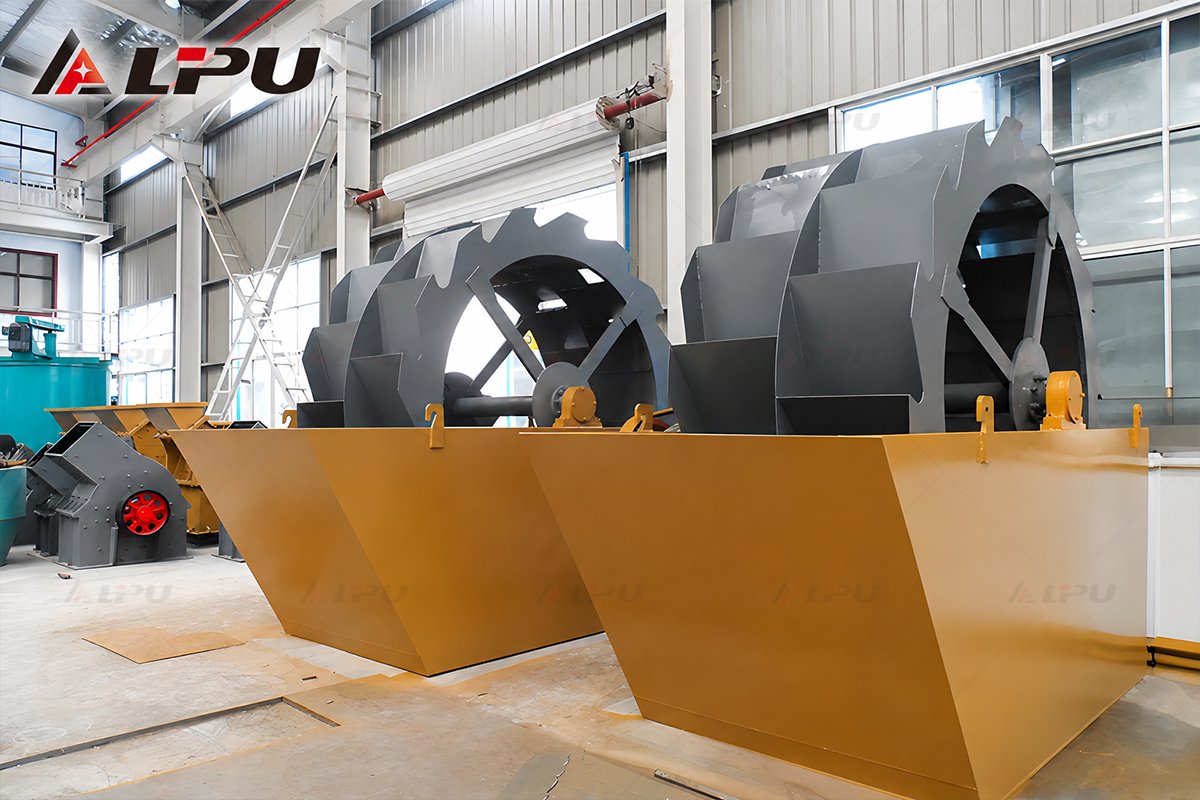
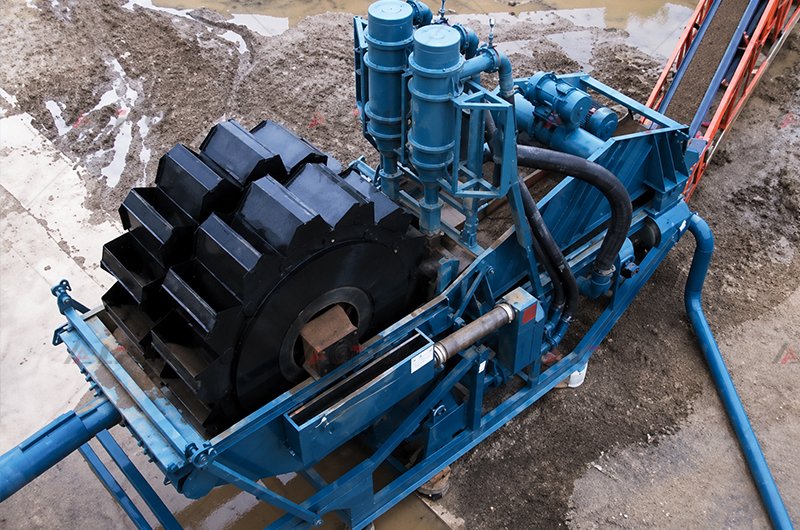
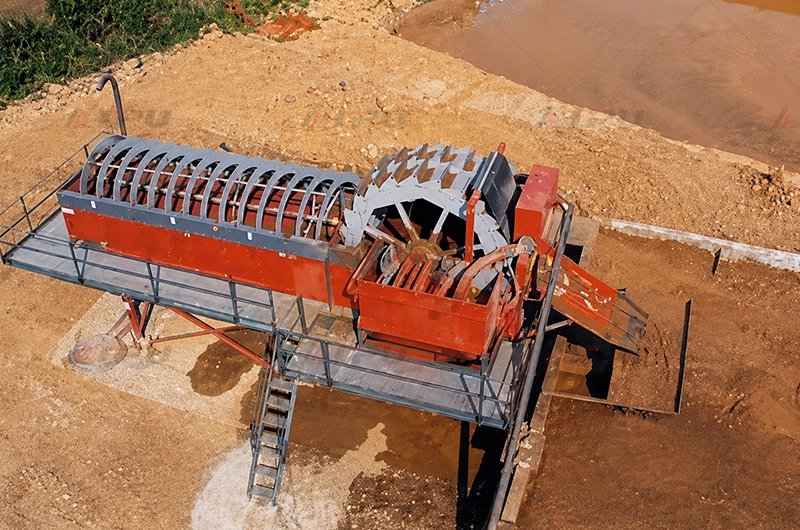
LIPU wheel bucket sand washing machines are designed for washing natural sand and manufactured sand after crushing, screening, or sand-making processes.
The slowly rotating bucket wheel washes away clay, silt, dust, and lightweight impurities while lifting the cleaned sand out of the washing tank for drainage and discharge.
Capacity: 15–200 t/h
Maximum Feed Size: ≤10 mm
Typical Applications: Manufactured sand, river sand, quartz sand, limestone sand, river pebble sand, and other washable fine aggregates.
A wheel bucket sand washing machine is a wet-processing machine used to clean sand and fine aggregate.
Bucket Sand Washer
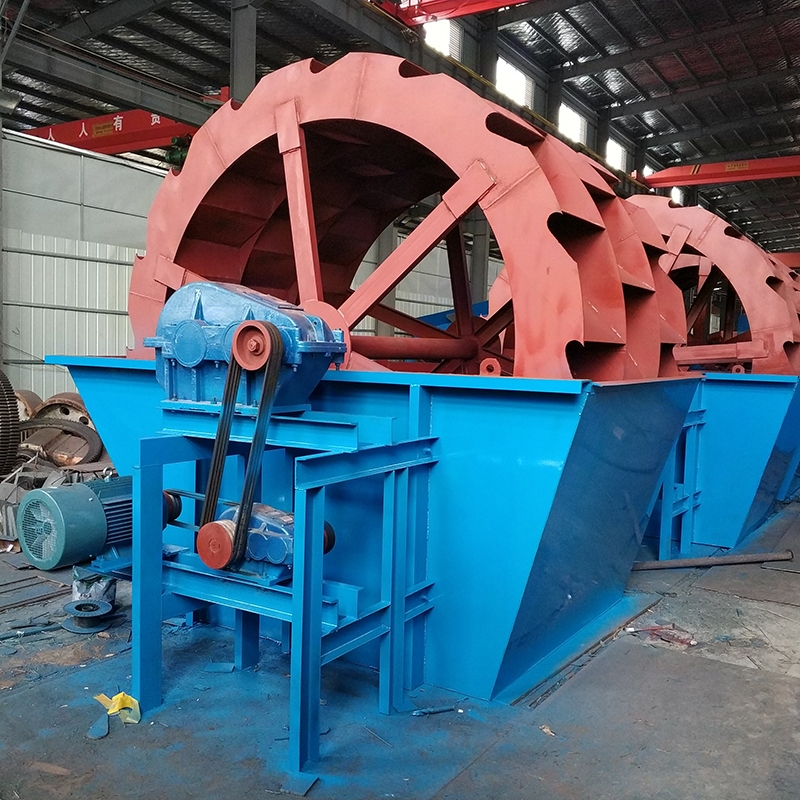
Bucket Sand Washer
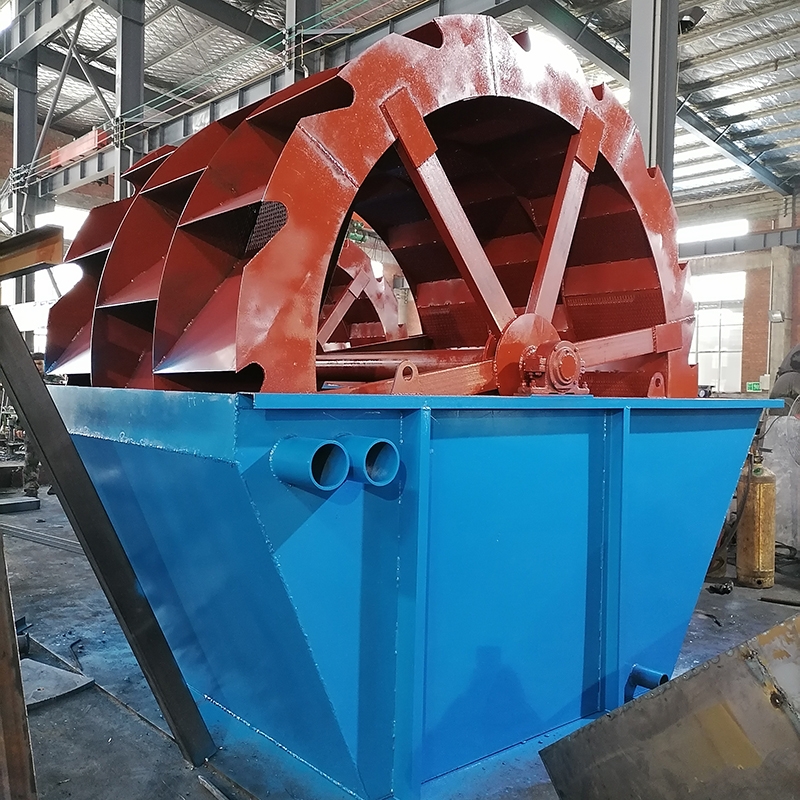
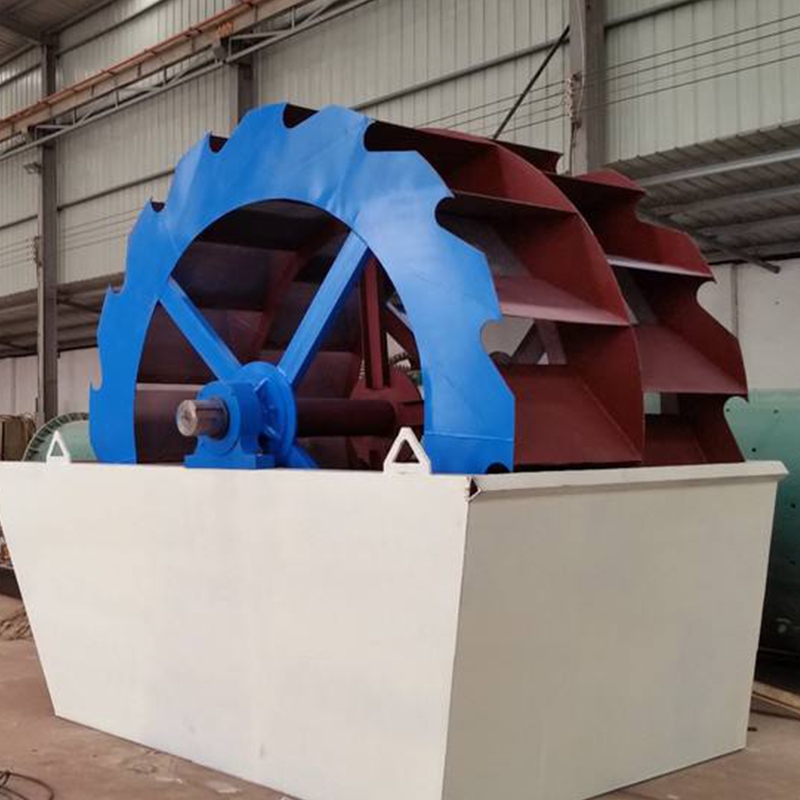
Bucket Sand Washer
During operation, sand enters the washing tank and is mixed with water. The rotating bucket wheel agitates the material, allowing surface dirt, silt, clay particles, and lightweight impurities to separate from the usable sand.
The cleaned material is then collected by the wheel buckets, lifted above the water level, partially drained, and discharged to the next process.
Wheel bucket washers are commonly used after sand-making and screening equipment where the main objective is to improve sand cleanliness while limiting unnecessary loss of usable fine material.
For applications requiring stronger agitation or more intensive washing, a spiral sand washing machine may be more suitable.
How Does a Wheel Bucket Sand Washer Work?
The washing process combines low-speed bucket-wheel rotation, water flow, particle agitation, and drainage.
Sand enters the washing tank through the feed section. The motor drives the wheel through the transmission system, causing the buckets to rotate slowly through the water.
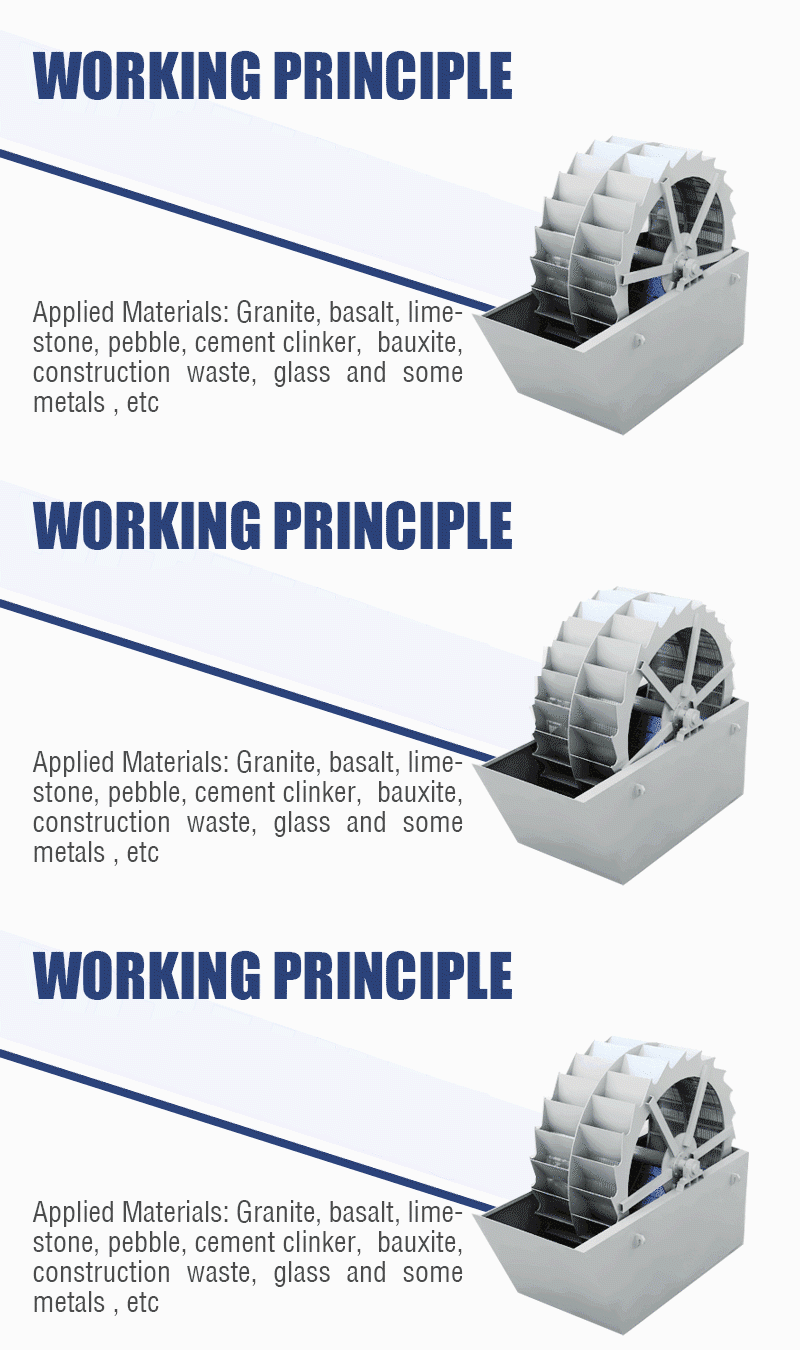
Working principle of wheel sand washing machine
During this process:
Water loosens dust, clay, and lightweight impurities from the sand surface.
The rotating wheel turns and agitates the material inside the washing tank.
Suspended impurities are carried toward the overflow area.
Clean sand remains inside the bucket sections.
The wheel lifts the washed sand above the water level.
Water drains from the material before discharge.
The actual washing result depends on the raw material, clay and silt content, particle-size distribution, water supply, feed rate, and required final-sand specification.
Why Use a Wheel Bucket Sand Washer?
Lower Loss of Usable Fine Material
The relatively gentle washing action helps reduce unnecessary loss of qualified sand compared with more aggressive washing conditions.
Fine-material retention still depends on the feed grading, water flow, bucket screen configuration, and operating conditions.
Transmission Components Away from the Main Washing Zone
The drive and transmission components are arranged separately from the main sand-and-water washing area.
This helps reduce direct exposure of important mechanical components to slurry, abrasive sand, and wash water.
Washing and Partial Dewatering in One Process
As the bucket wheel lifts the cleaned sand from the washing tank, part of the water drains before the product is discharged.
This helps reduce the amount of free water carried to the next processing stage.
Simple Mechanical Structure
The machine uses a relatively straightforward wheel, tank, shaft, and transmission arrangement.
This helps simplify routine inspection, maintenance, and replacement of normal wear components.
Suitable for Continuous Sand Production
Wheel bucket sand washers can be integrated into continuous manufactured-sand and aggregate-processing lines.
They are commonly installed after a VSI sand maker and vibrating screen when the finished sand requires additional washing.
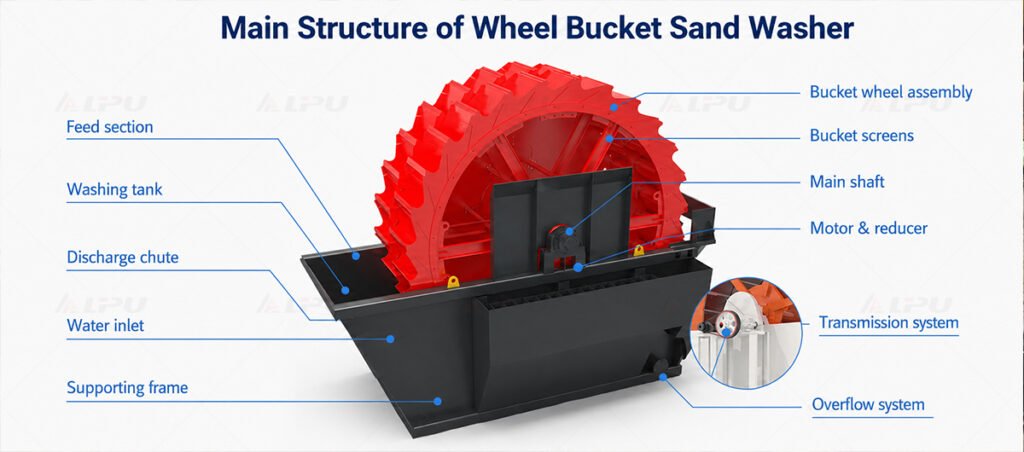
Main Components
A typical wheel bucket sand washing machine includes:
Main structure of wheel sand washing machine
Washing tank
Bucket wheel assembly
Bucket screens or perforated sections
Main shaft
Motor and reducer
Transmission system
Feed section
Discharge chute
Water inlet
Overflow system
Supporting frame
The bucket wheel is the main working component. It agitates, collects, lifts, drains, and discharges the washed sand.
The washing tank provides the water-and-material working area, while the overflow section removes suspended impurities and excess fine particles.
Suitable Materials and Applications
Wheel bucket sand washers are mainly used for natural sand, manufactured sand, and fine aggregate that can be effectively cleaned through water washing.
Typical materials include:
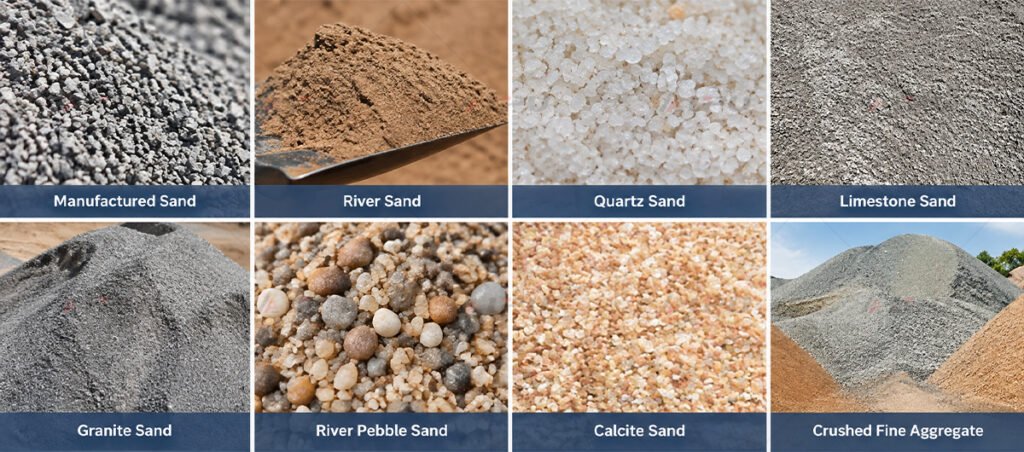
Typical materials suitable for wheel bucket sand washing in sand and aggregate processing applications
Manufactured sand
River sand
Quartz sand
Limestone sand
Granite sand
River pebble sand
Calcite sand
Crushed fine aggregate
Typical applications include:
Manufactured sand production
Aggregate washing
Quarry sand processing
Concrete aggregate preparation
Construction sand production
Natural sand cleaning
Sand-making production lines
Fine aggregate washing
The machine should not be selected only by material name.
Clay type, impurity content, particle-size distribution, fines retention requirements, and required product cleanliness are more important when determining the correct washing process.
Wheel Bucket Sand Washer vs Spiral Sand Washer
Wheel bucket and spiral sand washers both use water to remove impurities, but they apply different levels of material agitation.
Factor
Wheel Bucket Sand Washer
Spiral Sand Washer
Main washing mechanism
Rotating bucket wheel
Rotating spiral shaft
Material agitation
Moderate
Stronger
Typical duty
Sand cleaning and partial dewatering
Washing, agitation, grading, and conveying
Fine-material retention
Generally favorable under suitable operating conditions
Depends strongly on material and operating conditions
Structure
Compact wheel-and-tank design
Longer spiral trough
Best suited for
Manufactured sand and natural sand with moderate washing requirements
Materials requiring stronger washing or agitation
A wheel bucket washer is usually suitable when the sand mainly contains surface dust, loose silt, or relatively easy-to-remove impurities.
A spiral washer may be more appropriate when the feed contains more difficult clay, stronger contamination, or requires more intensive agitation.
The final choice should be based on material testing and actual washing requirements rather than machine type alone.
How to Select the Right Wheel Bucket Sand Washer
The correct model should be selected according to actual process conditions rather than nominal capacity alone.
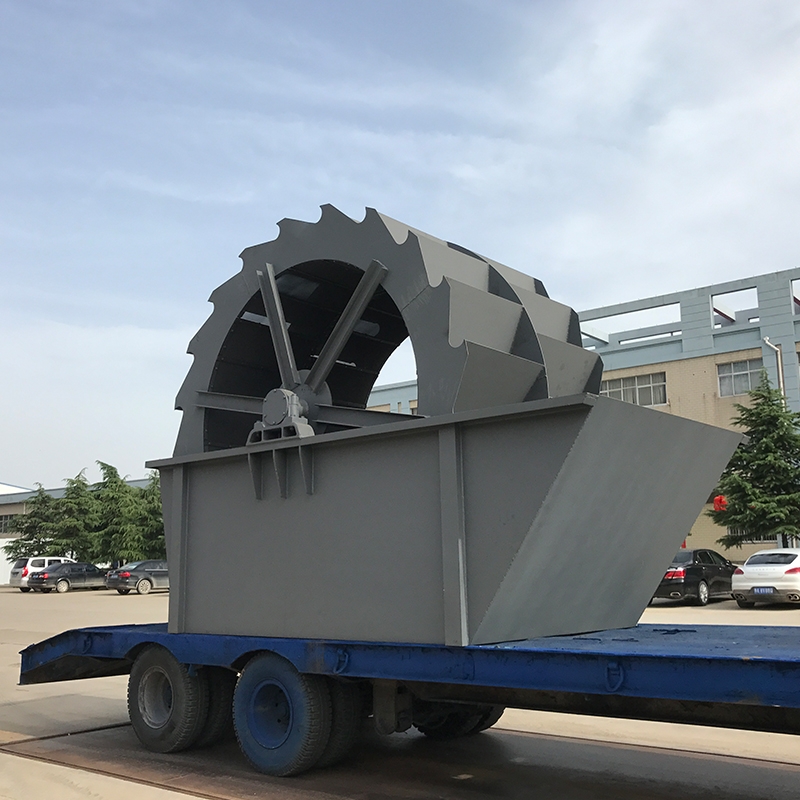
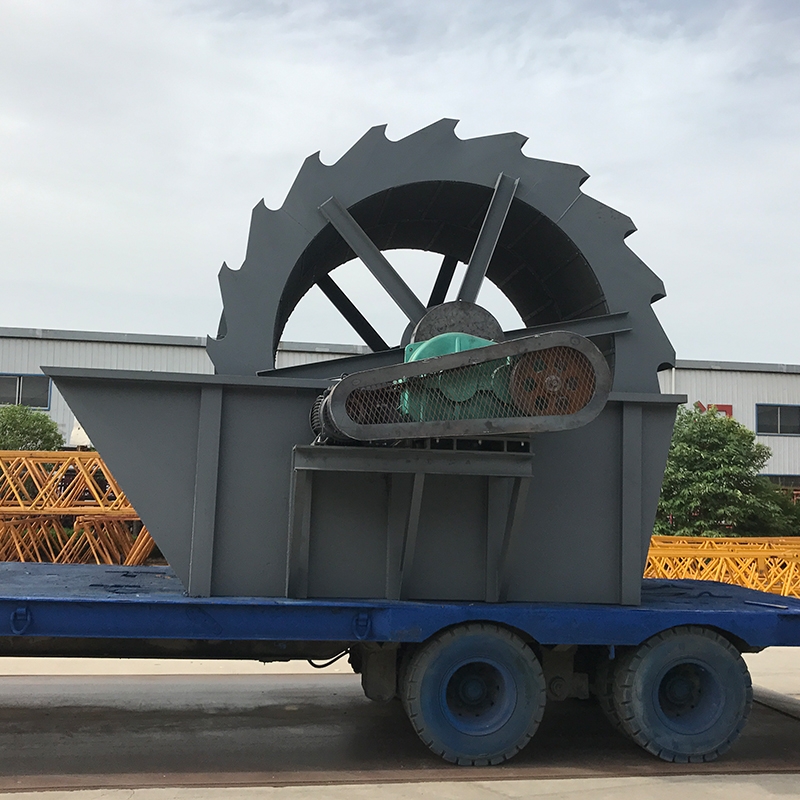
Wheel bucket sand washer side view
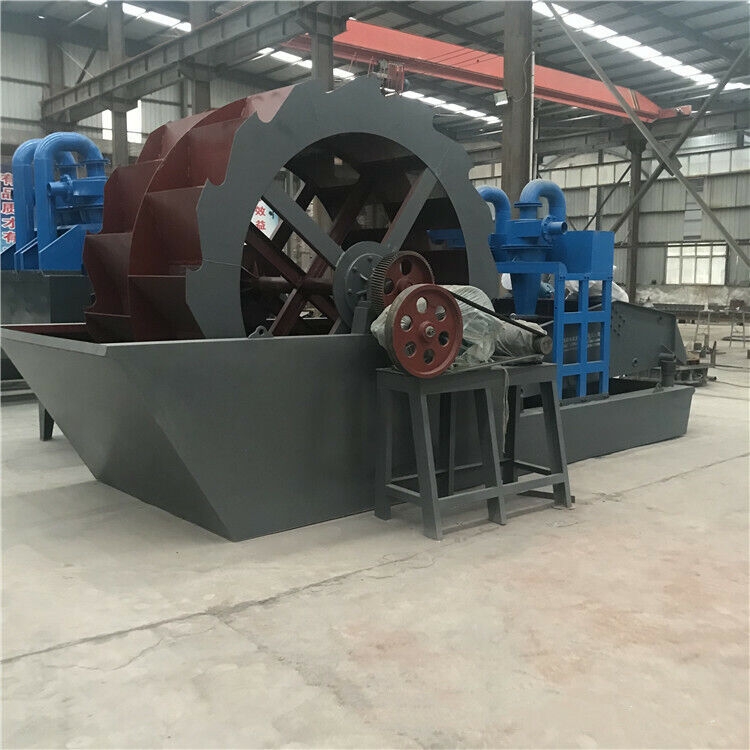
Wheel sand washing machine drive side
Wheel bucket sand washer factory view
Before selecting a machine, confirm the following information:
Required processing capacity
Maximum feed size
Feed particle-size distribution
Clay and silt content
Required finished-sand cleanliness
Amount of fine material that should be retained
Available process water
Water recycling conditions
Upstream sand-making and screening equipment
Downstream dewatering or stockpiling equipment
Available installation space
Feed Size
The current XS-series models listed on this page are designed for a maximum feed size of ≤10 mm.
Material larger than the allowable feed size should be screened or processed before entering the washer.
Required Capacity
The current model range covers approximately 15–200 t/h.
The selected machine should have sufficient operating margin for feed fluctuations rather than being sized only at the theoretical maximum production rate.
Clay and Silt Content
Material with a small amount of loose dust and silt can usually be handled by conventional wheel washing.
Sticky clay, clay lumps, or heavily contaminated feed may require stronger washing, scrubbing, or additional processing stages.
Fine Sand Retention
If retaining very fine sand is important, the complete washing circuit should be evaluated.
Water flow, overflow conditions, screen openings, and downstream fine-sand recovery or dewatering equipment can all affect fine-material loss.
Typical Sand Washing Process
A wheel bucket sand washer is rarely operated as an isolated machine.
It is usually part of a complete sand-making or aggregate-washing circuit.
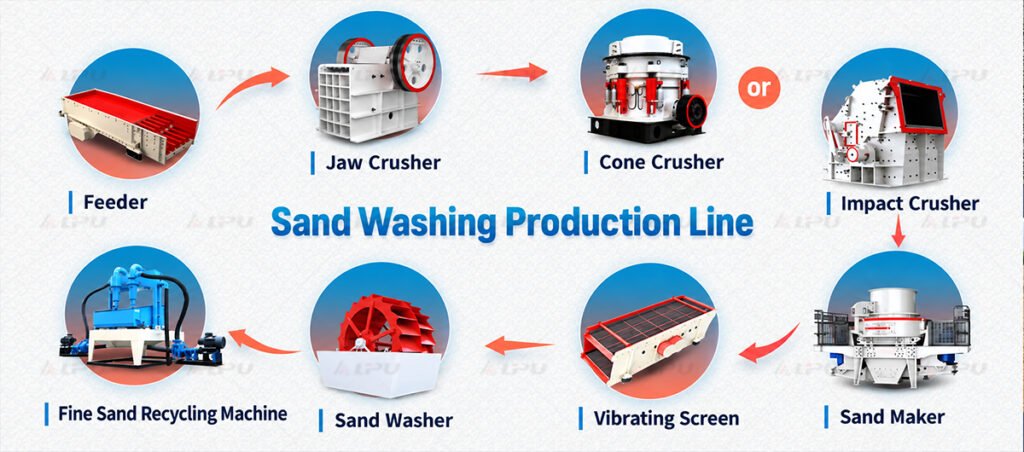
Typical sand washing production line showing crushing, sand making, screening, washing, and fine sand recovery stages
A typical manufactured-sand process may include:
Crushing → VSI Sand Making → Screening → Wheel Bucket Sand Washing → Dewatering or Stockpiling
For natural sand applications, the process may be simpler:
Where the feed contains more clay or difficult impurities, the circuit may require additional washing or scrubbing stages.
The final flowsheet should be determined according to the raw material and required finished-product specification.
Technical Parameters
Wheel Bucket Sand Washing Machine
Model
Wheel Bucket Diameter (mm)
Rotation Speed (r/min)
Maximum Feed Size (mm)
Capacity (t/h)
Motor Power (kW)
Overall Dimensions (mm)
Weight (kg)
XS22-2
2200
2.5
≤10
15–30
4
3180 × 1955 × 2350
2260
XS26-2
2600
2.5
≤10
20–50
5.5
3515 × 2070 × 2672
2500
XS28-3
2800
1.2
≤10
50–80
11
3964 × 3014 × 2895
3200
XS28-4
2800
1.17
≤10
60–100
15
3964 × 2137 × 2895
3580
XS30-4
3000
1.2
≤10
70–110
15
4169 × 3456 × 3055
3850
XS32-3
3200
1.0
≤10
80–120
15
4340 × 2760 × 3349
3950
XS32-4
3200
1.17
≤10
95–130
18.5
4346 × 2198 × 3345
4185
XS36-5
3600
1.0
≤10
110–200
22
4580 × 3218 × 3600
4600
The specifications above are based on the current XS-series data published for this product.
Actual capacity can vary with feed grading, material properties, impurity content, water conditions, and operating settings.
Final model selection should be confirmed according to the project requirements.
Customer Applications
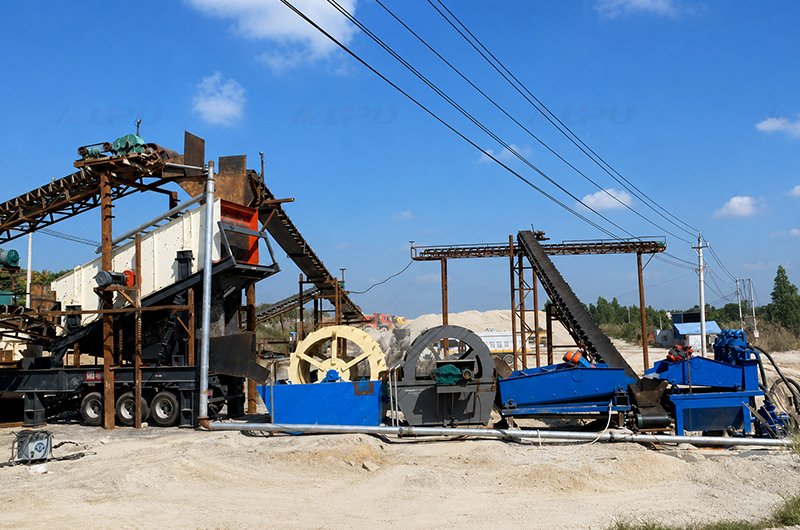
Wheel bucket sand washing machines can be used in both natural-sand and manufactured-sand processing projects.
Aggregate Washing / Sand-Making Production Line
Fine Aggregate Washing / Manufactured Sand Production
Quarry Sand Processing / Construction Sand Production
Typical installations include:
Manufactured sand plants
Quarry aggregate plants
River sand washing projects
Concrete aggregate production
Construction sand processing
Sand-making and screening lines
When evaluating a customer site, the washing machine should be considered together with the upstream screen, sand maker, conveyors, water supply, drainage system, and downstream dewatering equipment.
This helps ensure that the washer is matched to the entire production line rather than selected as an isolated machine.
Frequently Asked Questions
What is the main purpose of a wheel bucket sand washing machine? It is mainly used to remove dust, silt, clay, and lightweight impurities from natural or manufactured sand while lifting and partially draining the cleaned product.
What is the maximum feed size? The current XS-series models listed on this page are designed for feed sizes up to 10 mm.
What capacity range is available? The current model range covers approximately 15–200 t/h depending on the selected model and actual operating conditions.
Can a wheel bucket sand washer handle sticky clay? Only to a limited extent. Material with sticky clay or clay lumps may require stronger agitation, scrubbing, or a spiral washing stage before or after conventional sand washing.
Does a wheel bucket washer lose fine sand? Some fine particles can leave with the overflow water. The actual loss depends on particle-size distribution, water flow, machine configuration, and the complete washing circuit.
Should I choose a wheel bucket washer or a spiral sand washer? Choose according to the feed material and washing duty. Wheel bucket washers are generally suitable for moderate sand-cleaning duties, while spiral washers provide stronger material agitation for more difficult washing conditions.
LET US REACH YOUNeed detailed customization and latest price? Chat online or leave message below!
How we use cookies
This Cookie Privacy Policy statement explains how Zoneding Machine (hereinafter referred to as "we", "our", or "this website") uses cookies and similar technologies (collectively referred to as "cookies") to identify you when you visit our website lepuu.com. It explains what these technologies are, why we use them, and your rights to control our use of them.
Privacy Policy
Leave a Message
We will reply to you within 24 hours
Hello, I am Lipu Heavy Industry, what can we do for you please?